
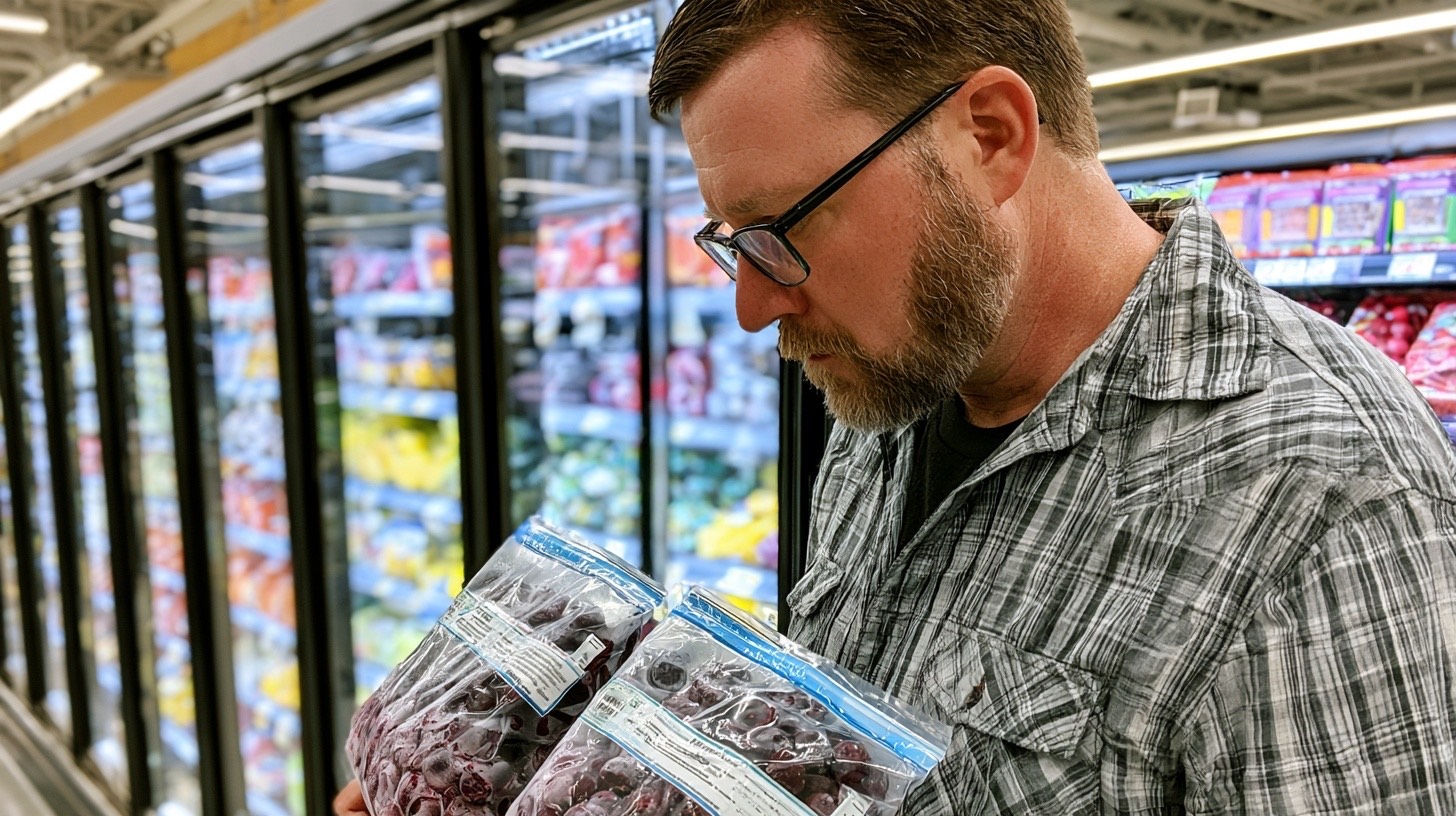
Frozen cherries are unusually practical for a small batch. They are picked and packed when usable, they need no destemming, and freezing ruptures cell walls that would otherwise need time and crushing to release color and juice.
They also create one predictable challenge: acidity. Tart cherries can produce a vivid, fragrant wine that feels almost electric when young. The answer is not to throw an arbitrary spoonful of alkaline powder into the fermenter. Good acid management begins by separating three different questions: what the drink is, how sour it tastes, and whether its chemistry supports a healthy fermentation.
Is it cherry wine or cherry cider?
If cherries provide the fermentable fruit base, the accurate name is cherry wine or fruit wine. In the United States, cider means wine fermented from apples. A mostly apple-based fermentation flavored with cherries may be described informally as cherry cider, although commercial labeling rules are more specific.
This recipe contains cherries, sugar, and water rather than an apple-juice base, so it is cherry wine. The distinction is useful: cider technique assumes apple juice chemistry, while fruit wine often requires deliberate choices about dilution, sugar, tannin, nutrients, and acidity.
The acidity problem: pH is not sourness
Cherry must can have a low pH and high titratable acidity. The numbers describe related but different things. Titratable acidity, usually shortened to TA, is more closely connected with how much sourness the palate experiences. pH governs many microbial, color, and sulfur-dioxide decisions.
Sugar can make acid taste less aggressive, but it does not remove acid. Water and blending reduce the acid concentration. Carbonates neutralize some acid and change the chemistry. Malolactic fermentation can soften malic acid, but it is a separate biological process that requires a compatible culture and conditions; it is not a dependable rescue step for an unmeasured beginner batch.
| Adjustment | What it changes | Main tradeoff |
|---|---|---|
| Water | Dilutes acid, sugar, color, and flavor together | Too much makes thin wine |
| Blend | Balances the batch with a lower-acid wine or juice | Changes the fruit profile |
| Backsweetening | Reduces perceived sharpness without removing acid | Requires stabilization and careful packaging |
| Potassium bicarbonate | Neutralizes some acid and raises pH | Excess can taste salty or dull and add potassium |
| Calcium carbonate | Neutralizes acid, often before fermentation | Can leave chalky character or deposits if overused |
| Time | Allows alcohol, tannin, aroma, and acidity to integrate | Does not truly remove acid |
Targets for a one-gallon batch
- Finished volume: 1 US gallon (3.8 L).
- Primary vessel: about 2 gallons (7.6 L), leaving room for fruit and foam.
- Original gravity: approximately 1.085–1.095.
- Potential alcohol: roughly 11–13% ABV if fermented dry; the actual value depends on measured original and final gravity.
- Fermentation temperature: generally 64–72°F (18–22°C), subject to the yeast manufacturer’s range.
- Acidity: record both pH and TA when possible; do not chase one universal number for every cherry variety and wine style.
This is a reference formulation, not a claim about one tested lot of fruit. Cherries vary enough that the sugar and acid correction must be based on the actual must.
Ingredients
- 3–4 lb (1.36–1.8 kg) frozen, pitted sweet or tart cherries
- Approximately 2–2.5 lb (0.9–1.13 kg) granulated sugar, added only as needed to reach the target gravity
- Chlorine-free water to make 1 US gallon (3.8 L)
- Wine yeast suited to fruit or red wine; use the manufacturer’s recommended amount
- Yeast nutrient, used according to its label and divided into additions when the product permits
- Pectic enzyme, used according to its label
- Optional tannin: a very small measured addition or a bench-tested cup of strong black tea
- Optional potassium metabisulfite and potassium sorbate for stabilization before backsweetening
- Optional potassium bicarbonate or calcium carbonate only after measurement and a bench trial
Do not substitute household baking soda by eye. Sodium bicarbonate can reduce acidity, but it adds sodium and can produce an unpleasant salty impression. Winemaking products are easier to weigh, document, and repeat.
Equipment
- A 2-gallon (7.6 L) food-safe primary fermenter with a loose-fitting lid or appropriate closure
- A sanitized mesh fruit bag
- A 1-gallon (3.8 L) secondary vessel with minimal headspace
- Brewing sanitizer, spoon, siphon, and bottles
- A scale and thermometer
- A hydrometer for original and final gravity readings
- A calibrated pH meter or fresh narrow-range wine pH strips; a titration kit is better for acidity decisions
Step-by-step method
1. Choose and thaw the fruit
Buy unsweetened, pitted frozen cherries with no sauce or preservatives. Sweet cherries usually give a rounder base; tart cherries contribute more vivid aroma and sharper acidity. Thaw the sealed fruit in the refrigerator, keeping all of the released juice. Freezing has already broken many fruit cells, so extraction begins quickly.
2. Sanitize and contain the fruit
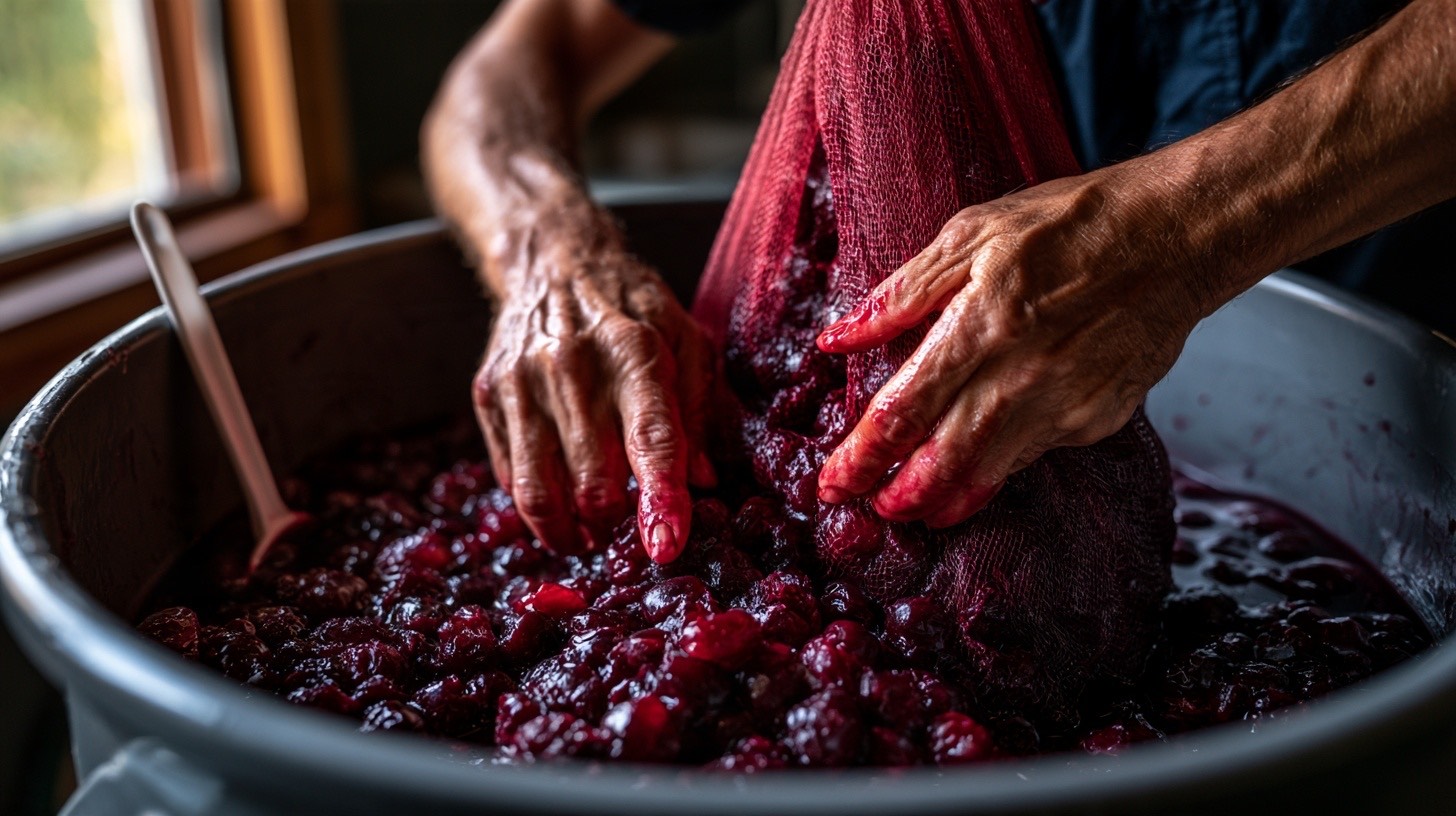
Clean and sanitize every surface that will contact the must. Put the thawed cherries and their juice into a sanitized mesh bag inside the primary fermenter. Lightly crush them with a sanitized spoon or clean hands. Do not pulverize any missed pits: damaged cherry stones can add harsh almond-like character and are not an ingredient.
3. Build the must gradually
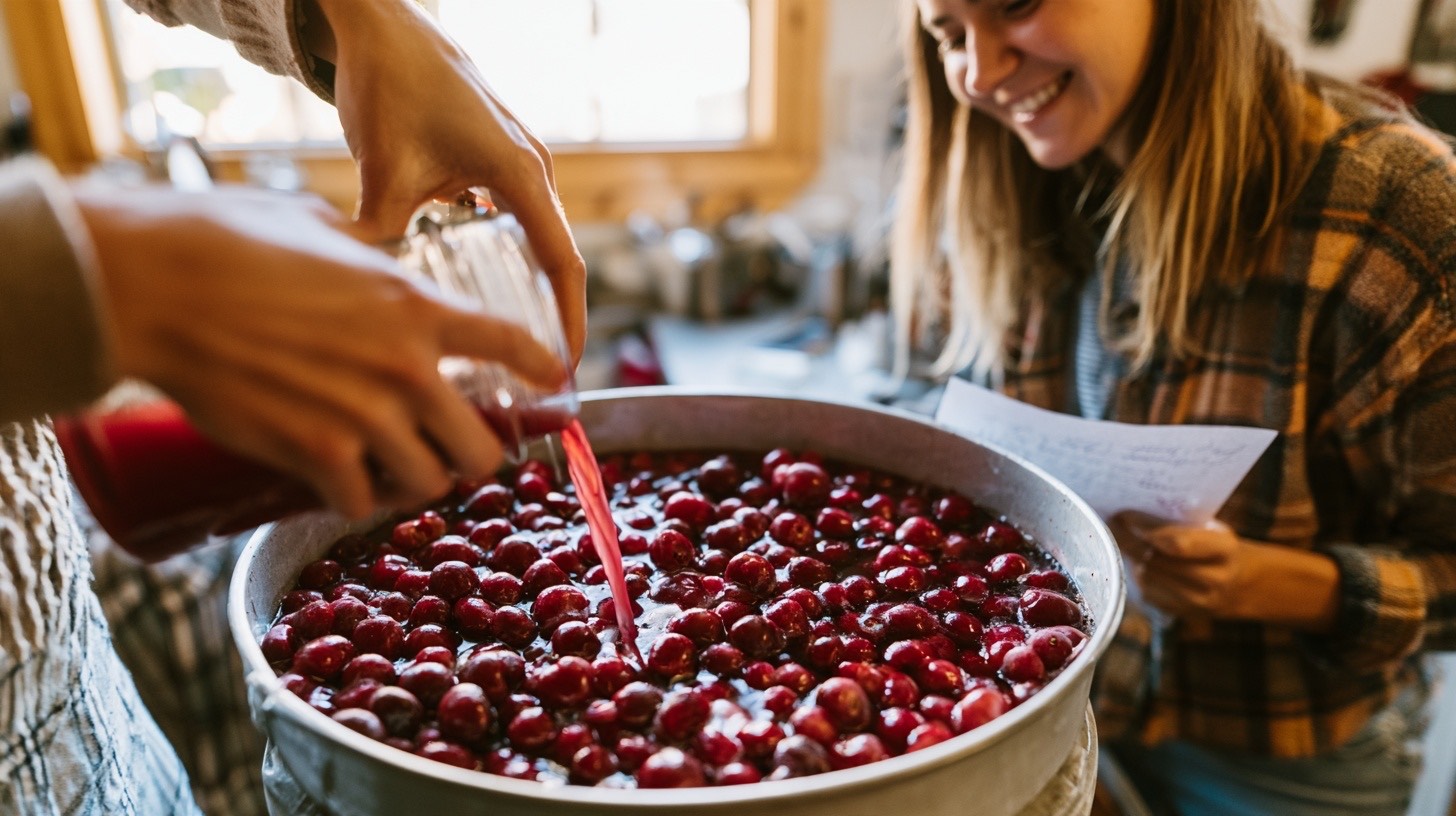
Dissolve part of the sugar in warm water, cool it, and add it to the fruit. Add more chlorine-free water, but stop short of the final gallon so there is room to adjust. Mix thoroughly and take a gravity reading. Add sugar syrup in small increments until the must reaches about 1.085–1.095 SG. The exact weight of sugar varies because the cherries already contain sugar.
4. Measure acidity before correcting it
Record pH, and measure titratable acidity if you have a kit. Taste a small sample. pH and perceived sourness are related but not interchangeable: titratable acidity tracks sourness more closely, while pH guides microbial and chemical decisions. Do not add a carbonate simply because raw cherry must tastes sharp; fermentation removes sugar and changes the balance.
5. Make the least invasive adjustment
If the must is intensely sharp, first test a small sample diluted with water or blended with a lower-acid juice. Scale up only the version that still tastes recognizably like cherry. A little residual sweetness later can balance acidity without chemically removing it. If measurement and a bench trial still support deacidification, use a winemaking carbonate in small weighed increments, following its product label. Mix, wait, retest, and stop before the wine tastes flat or chalky.
6. Add enzyme, nutrient, and yeast
Add pectic enzyme according to its label; it helps release juice and reduces persistent pectin haze. Add the first nutrient portion if your product’s instructions call for it. Pitch a reliable wine yeast at its recommended temperature. Keep the fermenter where the must can remain around 64–72°F (18–22°C), unless the yeast manufacturer specifies a narrower range.
7. Manage primary fermentation
During the first active days, open the primary only as needed to push the fruit bag beneath the surface with a sanitized utensil. Watch temperature, aroma, and gravity rather than counting airlock bubbles. Remove and gently drain the fruit bag after roughly five to seven days, or earlier if extraction is already strong and the fruit begins to lose fresh aroma. Do not squeeze so aggressively that pulp and seeds are forced through the bag.
8. Transfer by condition, not calendar
When vigorous fermentation has eased and gravity is approaching the dry range, siphon into the smaller secondary vessel, leaving sediment behind. Minimize headspace after active fermentation. Continue recording gravity until the reading is stable. A finish near 0.995–1.005 is common, but the stable trend matters more than a single target number.
9. Age before deciding the final balance
Young cherry wine can taste thin, hot, or sharply acidic. Give it several weeks, then taste a measured sample. If it is clean but severe, run small bench trials: a little sugar for balance, a lower-acid wine for blending, or a carefully measured carbonate correction. Write down each sample size and addition so the chosen treatment can be scaled accurately.
10. Stabilize, sweeten, and package safely
Dry, still wine may be bottled only after gravity is stable and the wine is clear enough for the chosen style. If you backsweeten, use a validated stabilization method and manufacturer directions; adding sugar to an unstabilized wine can restart fermentation in the bottle. Do not bottle a sweet or apparently quiet wine under pressure unless you have a controlled carbonation method and pressure-rated packaging.
How to run a useful bench trial
- Prepare several identical 3.4 fl oz (100 mL) samples of the wine or must.
- Keep one sample unchanged as the control.
- Add a different, precisely measured treatment to each remaining sample.
- Mix thoroughly and allow the treatment the time stated by its manufacturer.
- Retest pH or TA as appropriate, then taste the samples side by side.
- Choose the smallest addition that improves balance without erasing cherry character.
- Scale the addition from the sample volume to the actual measured batch volume.
For example, an addition tested in 100 mL must be multiplied by approximately 38 to treat one US gallon. Use a scale capable of measuring the resulting amount; kitchen teaspoons are too imprecise for tiny trials.
What to record
- Cherry type, brand or source, frozen weight, and whether the fruit was sweetened.
- Water and sugar actually added—not just the planned amounts.
- Original gravity, pH, TA if available, and sample temperature.
- Yeast strain, nutrient product, dose, and timing.
- Daily fermentation temperature and notable aromas.
- Date the fruit was removed and volume lost with the pulp.
- Every transfer, gravity reading, acid treatment, blend, and sweetness trial.
- Final gravity, packaging method, and tasting notes after conditioning.
Common mistakes
Correcting acid before measuring
Raw must often tastes harsher than the finished wine. Blind correction can leave a flat, unstable result with less cherry definition.
Adding all the sugar from a fixed recipe
The fruit contributes variable sugar. Use the hydrometer target to decide what the must still needs.
Fermenting in a one-gallon jug with the fruit
Fruit and foam need space. A larger primary vessel prevents messy overflow and makes the cap easier to manage.
Leaving fruit exposed at the surface
A floating, drying cap is vulnerable to oxidation and spoilage. Keep it wet during active fermentation and remove it once useful extraction is complete.
Sweetening and immediately bottling
Fermentable sugar can restart fermentation. Stable gravity before sweetening does not guarantee stability afterward.

Variations
Sweet-cherry wine
Use ripe dark sweet cherries for a softer, rounder style. They may need less dilution, but can benefit from a small tannin trial if the finish feels broad or simple.
Tart-cherry wine
Expect brighter acidity and a more forceful aroma. Begin with the lower end of the fruit range, preserve some room for dilution, and plan to assess sweetness after fermentation.
Cherry-apple wine
Replace some water with preservative-free apple juice. This produces a blended fruit wine with more body and apple character; it is still not the same formulation as an apple cider merely flavored with cherries.
Sparkling cherry wine
Do not improvise this version. Residual sugar, carbonation, and pressure require a controlled method, accurate calculations, and pressure-rated bottles.
Sources and method notes
The distinction between cider and other fruit wine follows the U.S. Alcohol and Tobacco Tax and Trade Bureau’s Cider FAQs. The difference between pH and titratable acidity, and their separate roles in taste and wine stability, is summarized by Penn State Extension. Penn State’s guidance on malolactic fermentation also explains why MLF is a managed process rather than a casual acidity shortcut.
Addition rates vary by product, fruit chemistry, and desired style. Follow the current manufacturer’s label and perform a bench trial before treating the full batch.